
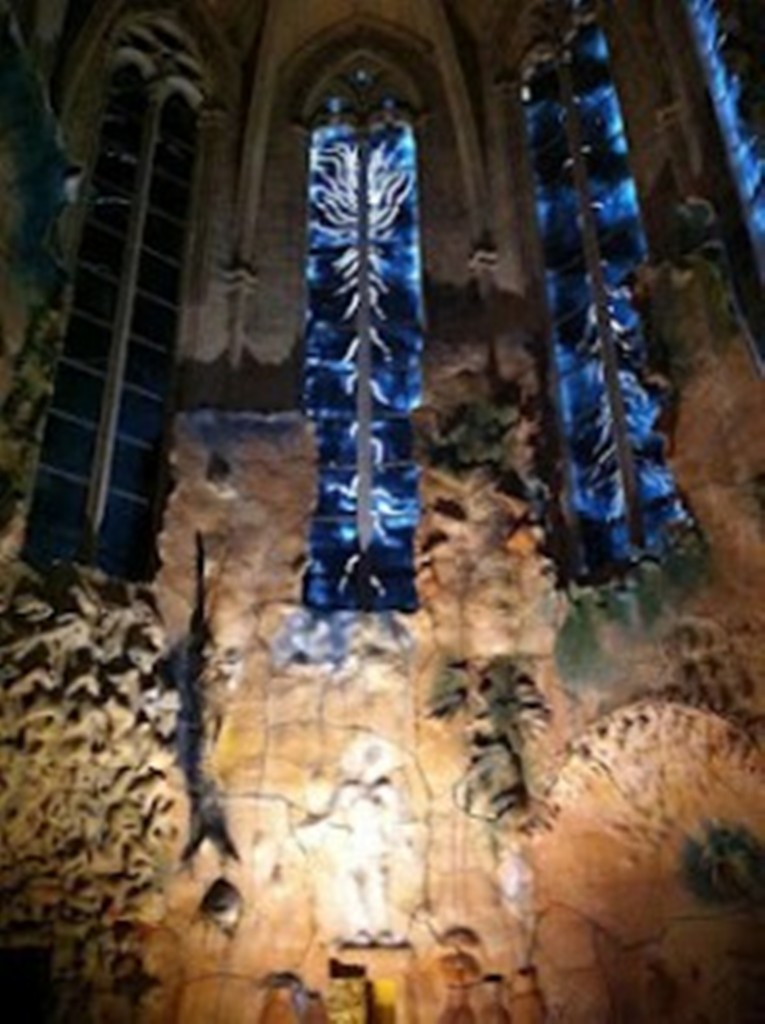
Chapel of the Holy Sacrament, Mallorca Cathedral
I find myself drawn to the daily news like a blow fly to a freshly steaming heap of excrement. I’m wearing my seasonal outfit, a thick blanket of fog. It suggested itself to me at the beginning of October as a substitute for any and all of my happier wardrobe options. While my senses are acutely attuned to the plastic geegaws, shiny baubles and jingle bell muzak designed to draw shoppers to the high street, I’m not at all tempted. No. I’m in the mood to pick through reports of atrocities in the Middle East, terrorist plots and attacks, yet another mass shooting in the USA.
Only a week ago we were in Soller, Mallorca — sunshine, trees laden with oranges and lemons, warm weather, walks; fresh vegetables, fruit, and local delicacies to be had cheaply at the market. Sunshine and exercise are antidotes to depression. So is food. I can shop for it, cook it, serve it and eat it.
Mallorca Cathedral’s chapel of the Holy Sacrament celebrates food.
The cathedral as a whole is a splendid French Gothic affair, all but one of its chapels glittering with gilt ormolu tracings, magnificent statuary and paintings — the whole lit from lofty many-coloured rose windows. The subtle play of light is augmented by Gaudi’s electric lanterns.
Miquel Barcelo’s Holy Sacrament chapel is in the apse to the right of the high altar. At first glance it’s a startlingly crude piece of work. A large terracotta cave. But under water. Seaweeds deck the windows and walls. It is a painting where clay sculpture erupts from the canvas. A huge clay diorama baked too fast in an enormous kiln so that the clay has developed a pattern of deep cracks. It’s a model of a brain wherein thoughts, fears and desires, take physical form and burst out from the tissue. It’s an atrium of a beating heart or a womb to experience rebirth. You may read its meanings through your own experience, your own prejudices, longings, fears.
The chapel was created for the celebration of the Holy Eucharist. In its design Barcelo employed two main motifs, two parables: Jesus feeds the multitude; Jesus turns water to wine at Cana. Loaves and fishes, cabbages, crabs and watermelon, clay vessels for cooking, eating and drinking, are suspended in the walls. Memento mori cry the tumbled skulls. The portrayal of the risen Christ is central – yet it is neither here nor there; it is a human form, but rendered in blurry incorporeal light tones; emerging from the clay rather than superimposed on it. I did not see it for some minutes. Then a sudden shock as I see the five wounds and recognize them for what they are – slits with proud edges of swollen bloody flesh. Time and place disappear. The host lives here.

 annewlindsay
 annewlindsay
Having just visited the chapel you write about Anne – thank you for that beautiful description. I passed it onto my boyfriend back in the UK who isn’t on our trip as it did the job of describing more than my photographs could. Lovely blog. The type of thing the internet was design for.
Thanks Annie! I love hearing that the chapel was special for you as it was for me. I hope your boyfriend gets to go with you next time (if you decide to visit Mallorca again).
I didn’t see it the same way. It’s a pictorial of a church in disarray. The figure of Jesus is eroded. His being the way to salvation, eroded. Images of what happened happened at Cana and when the loaves multiplied is transformed into skulls. The death of miracles. A parched earth, cracking, covered in an illusion of a sea and fruitful earth. The stains on the glass, blacked with streaks of lightning. Final judgements on humanity. Can’t say it doesn’t represent a truth.
thanks for commenting Lcanella. I’ve neglected this blog for seven years — I’ve kept up the annual stipend but wrote nothing.
I’d quite the rigmarole getting in today — forgot my password, etc etc. Your comment came up in my email you see and I needed to reply to you. The chapel made a huge impact on me — and on you. What is interesting to me is your take on it. I visited the chapel 8 years ago — I believe if I’d visited it yesterday I’d have seen what you saw — a vision showing how we’re destroying the earth, the creation. Scripture is miraculous. You read a text one year and it has a certain meaning. Read it the next and you see something else. Keats, the poet, talked about ‘negative capability’ — meaning the capacity of a medium to hold many interpretations simultaneously or sequentially. Gaudi managed that.
Thank you for replying back.
I realized that your post was made years back, but thought I’d share some of my impressions.
As you say there are many interpretations.
On the flip side, the artist who agnostic, and the art could represent a breaking through of the spirit. The darkness of what would be the clear windows transmitting light, is split by that light, fearsome perhaps at first like lightning. The skulls take on a new form: the miracles of the loaves and of the wine at Cana, the promise of new life. The dry cracked earth of the medium, is to be refreshed, to be bathed in the ocean of God’s compassion, the earth renewed. The reality of Jesus is emerging from the formless background.
Thank you for replying back.
I realized that your post was made years back, but thought I’d share some of my impressions.
As you say there are many interpretations.
On the flip side, the artist who agnostic, and the art could represent a breaking through of the spirit. The darkness of what would be the clear windows transmitting light, is split by that light, fearsome perhaps at first like lightning. The skulls take on a new form: the miracles of the loaves and of the wine at Cana, the promise of new life. The dry cracked earth of the medium, is to be refreshed, to be bathed in the ocean of God’s compassion, the earth renewed. The reality of Jesus is emerging from the formless background.